
There has been a lot of recent interest in reducing drag on surfaces using bubbles with potential applications ranging from drag reduction of underwater vehicles to pressure drop reduction in liquid pipelines. This includes primarily two broad methods, one utilizing “textured hydrophobic” surfaces, and the other more classical approach is to inject small bubbles from the surface into the flow. We have done work related to both approaches as detailed below.
1. Bubble injection into the flow
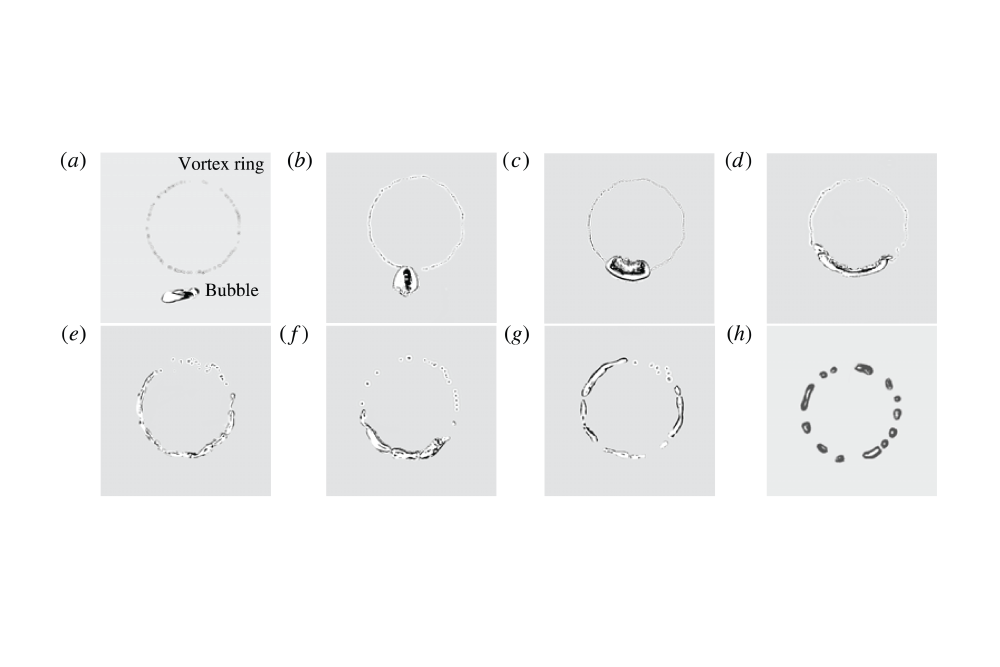
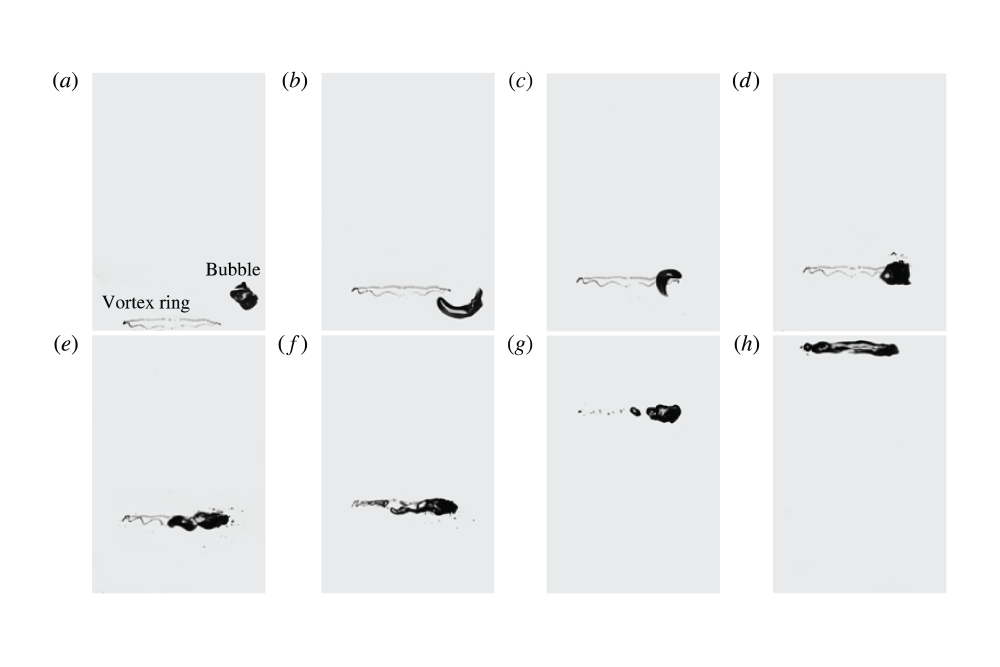
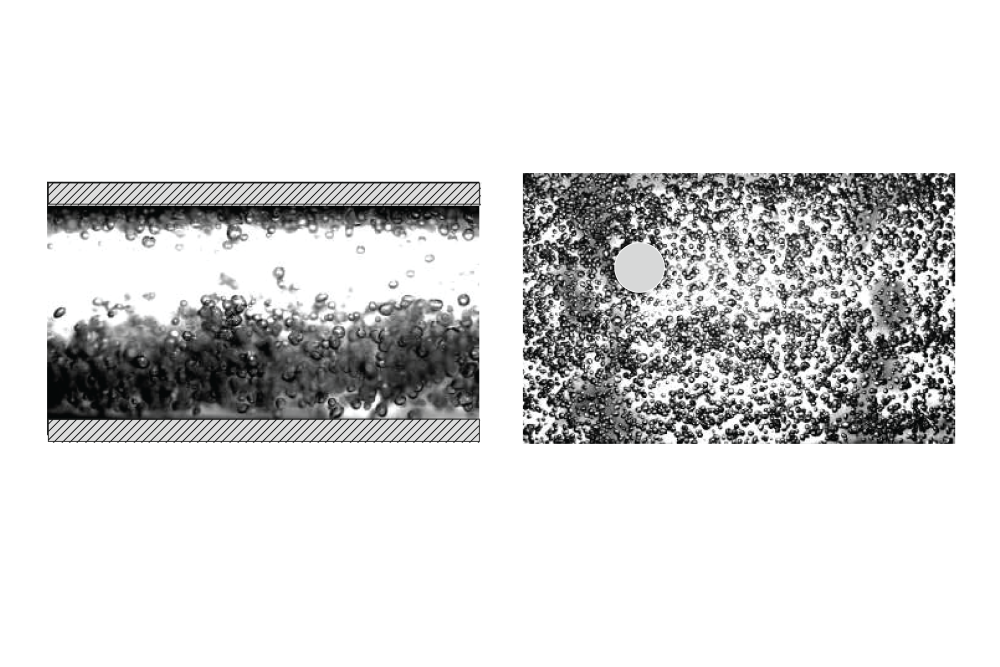
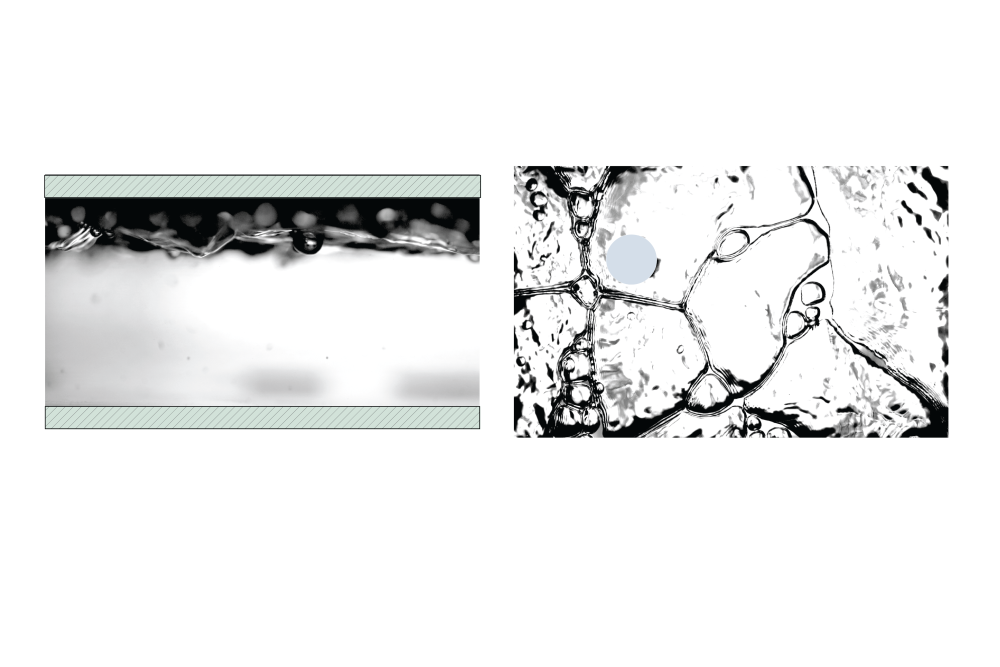
In the approach using injected bubbles into the flow, drag reduction by bubbles can either be caused by direct modification of fluid properties like density and viscosity, or through the relatively more complex interaction of bubbles with turbulent structures within the boundary layer.
In this broad area, we have studied:
- Single bubble – Vortex ring studies: An idealization of the interaction of bubbles with turbulent structures is the interaction of a single bubble with a single vortical structure, namely a vortex ring (formed in water). In these studies, measurements of both the bubble dynamics and vorticity dynamics have been done to help understand the two-way coupled problem over a large range of vortex ring and bubble parameters. The results from these studies show that they exhibit many phenomena also seen in bubbly turbulent flows such as reduction in enstrophy, suppression of structures, enhancement of energy at small scales and reduction in energy at large scales. These similarities suggest that results from the present experiments can be helpful in better understanding interactions of bubbles with eddies in turbulent flows.
- Drag reduction using bubbles in turbulent channel: We have also studied actual drag reduction in a turbulent channel flow by the injection of bubbles. We have systematically mapped out the effect of different rates of bubble injection, on the drag reduction (pressure drop) achieved within a turbulent channel. These results show that there exist many different regimes of bubble dynamics in the flow depending on the rate of bubble injection and the channel Reynolds numbers. The measured drag (or pressure drop) is found to be greatly dependent on the bubble dynamics regime with possibilities of both enhanced drag and reduced drag compared to the reference no bubble case. When the conditions are right, very large drag reductions of up to 60 % were achieved.
2. Trapped bubbles on the surface – Superhydrophobic surfaces:
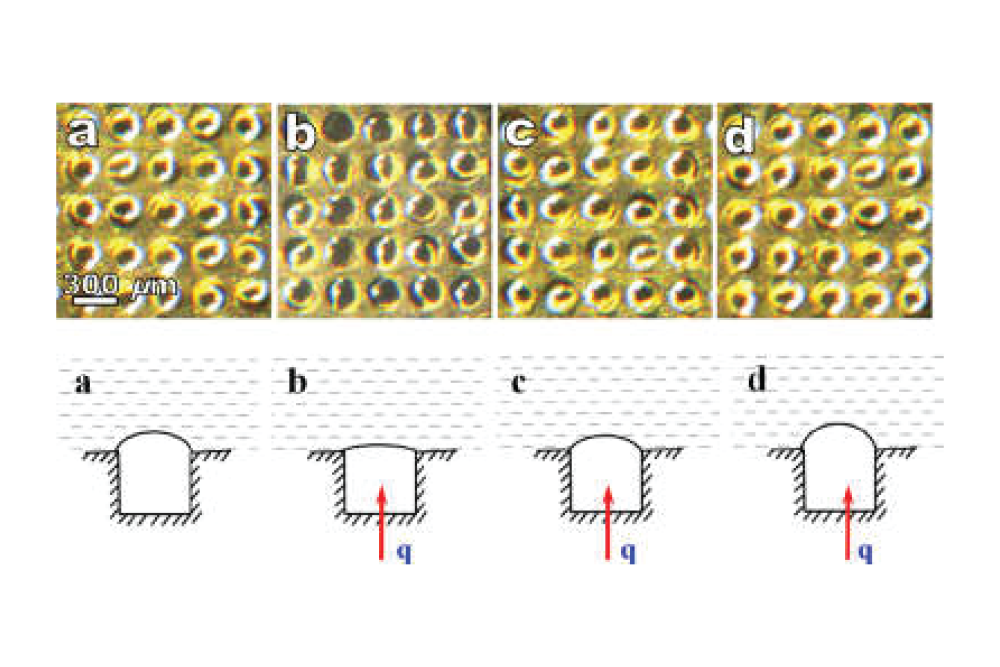
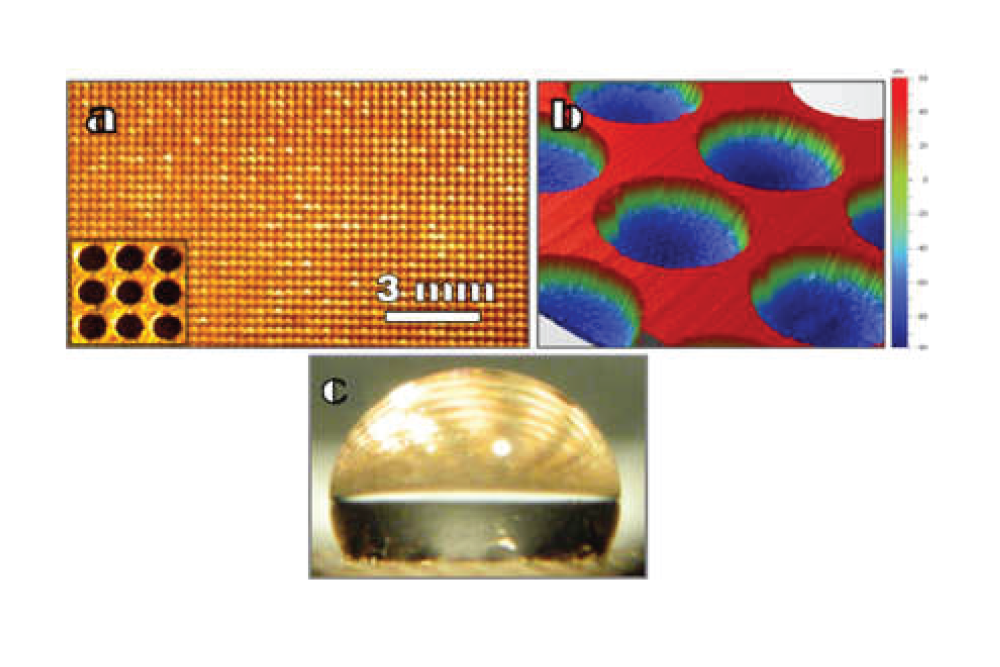
In contrast to the injection of bubbles, another mechanism for drag reduction is the use of “textured hydrophobic surfaces” as channel walls. The ability of these surfaces to provide substantial drag reduction has been attributed to the presence of air bubbles trapped on the surface cavities. However, this drag reduction cannot be sustained due to gradual dissolution of trapped air into water. In our recent work, we have explored the possibility of sustaining the underwater Cassie state of wetting in a microchannel by controlling the solubility of air in water; the solubility being changed by controlling the local absolute pressure near the surface. We show that using this method, we can in fact make the water locally supersaturated with air thus encouraging the growth of trapped air pockets on the surface. In this case, the water acts as a pumping medium, delivering air to the crevices of the hydrophobic surface in the microchannel, where the presence of air pockets is most beneficial from the drag reduction perspective.