
We have been studying high-speed (transonic/supersonic) flows with shocks focusing on the unsteady aspects of these flows. Some of the main projects in this area are:
- Shock Boundary layer interactions over a forward-facing step
- Transonic Flutter of aero-engine compressor blades
- Jet in supersonic cross-flow
- Stall in high-speed centrifugal compressors
1. Shock Boundary layer interactions over a forward-facing step
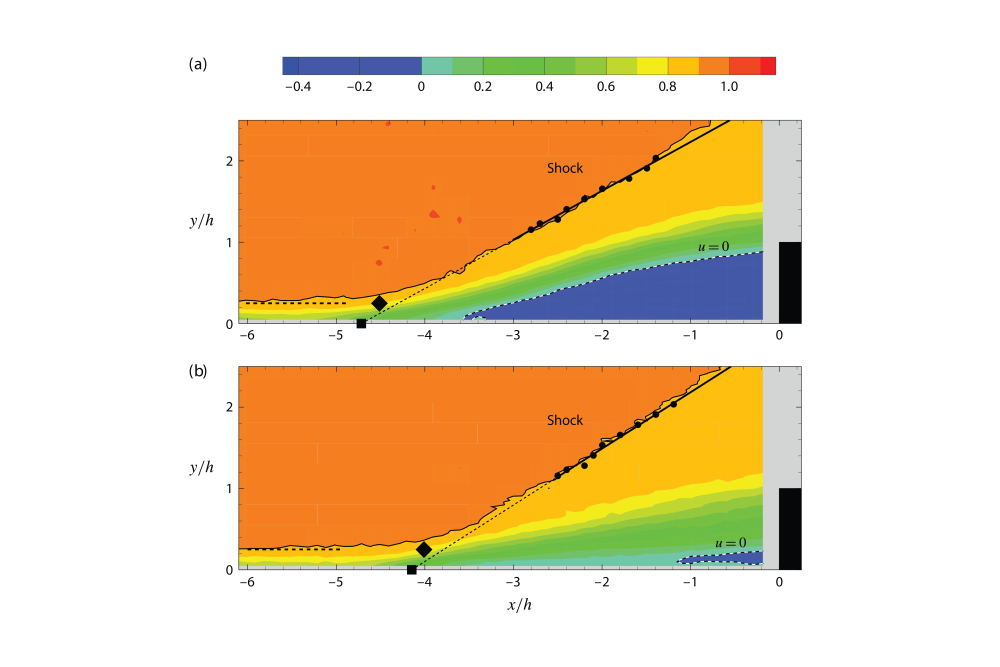
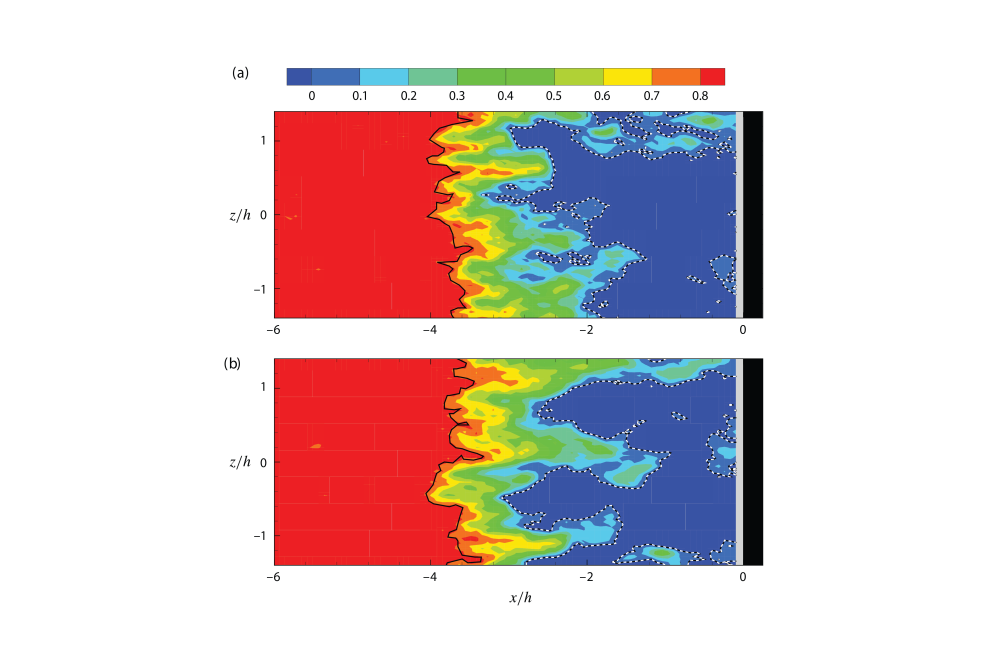
We have studied a Mach 2.5 flow over a forward-facing step (Narayan & Govardhan, 2015). The focus of the work was the flow ahead of the step, in particular, the interactions between the shock, the boundary layer, and the three-dimensional separation bubble with time. Detailed PIV measurements in two orthogonal planes were done in addition to unsteady wall pressure measurements upstream of the step. The mean velocity field in the central x-y plane shows that the incoming boundary layer separates upstream of the step forming a large separation bubble ahead of the step, which can be relatively well resolved in PIV measurements compared to the compression ramp cases. On the temporal side, the wall pressure fluctuation spectra close to the separation location show a dominant frequency that is two orders smaller than the characteristic frequency of the incoming boundary layer (fδ/U ~ 0.01), consistent with low frequency motions of the shock that has received a lot of recent attention (Clemens & Narayanaswamy 2014). PIV measurements in the cross-stream plane show large variations in shock position with time, the shock being measured well outside the boundary layer. This shock is found to be well correlated with the reversed flow area ahead of the step, as shown by conditionally-averaged PIV fields. Measurements in the other plane parallel to the lower wall show that the shock is broadly two-dimensional with small spanwise ripples, while the recirculation region is highly three-dimensional. The spanwise-averaged shock location is found to be determined mainly by the most upstream location of the recirculation region over a spanwise area. Hence, the present results suggest that for the forward-facing step configuration, it is the most upstream point of the recirculation region that is very important in deciding the shock location ahead of the step. On the other hand, the shock foot is found to have ripples that are well correlated to the streaks in the incoming boundary layer.
2. Transonic Flutter of aero-engine compressor blades
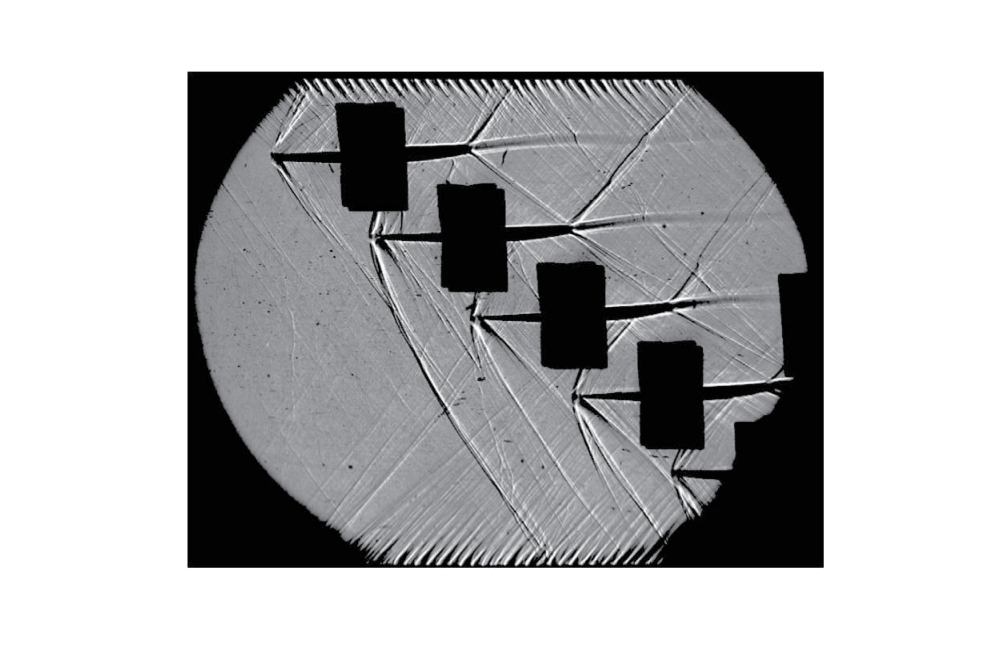
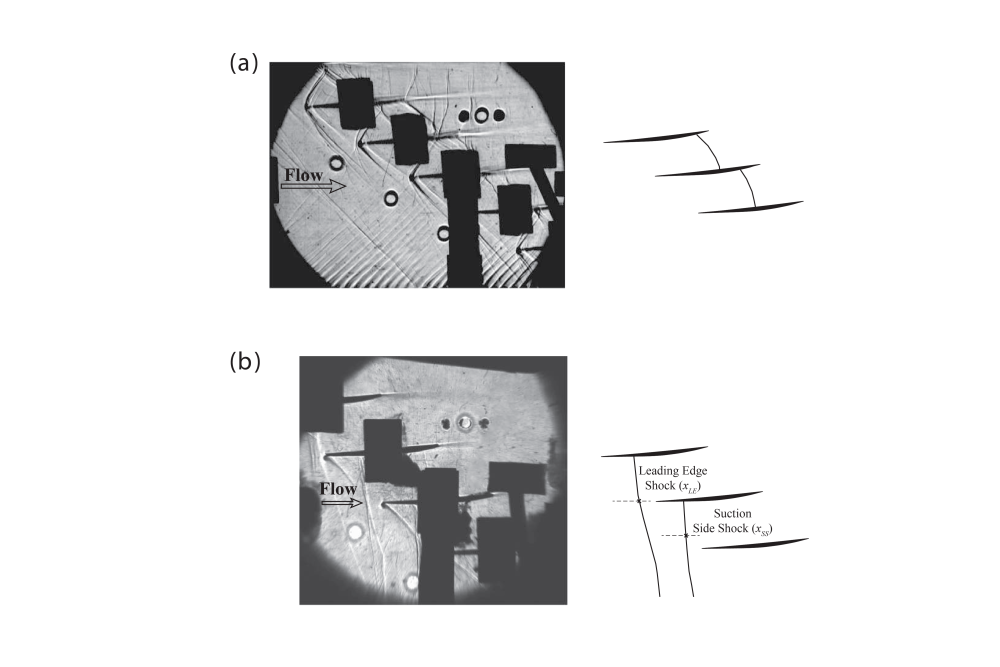
We have experimentally studied heave mode flutter of a blade within a linear cascade at transonic conditions. Driven by the motivation to understand the contribution of shock location/dynamics to flutter characteristics, we have performed simultaneous measurements of shock dynamics using high-speed shadowgraphy combined with unsteady load measurements on an oscillating blade within the cascade. The flutter characteristics in terms of energy transfer from the fluid to the blade and shock dynamics have been mapped out over a range of blade oscillation frequencies and static pressure ratios (SPR) across the cascade, the latter being important as it decides the mean location of the passage shocks. SPR values studied include both conditions where the shock is within the passage (started cascade) and where the passage shock is pushed ahead of the leading edge of the blades (unstarted cascade). These measurements show characteristically different flutter behavior for an unstarted cascade compared with a started cascade, the former having received very little attention in the literature. While both these cases show small excitation levels at low reduced frequencies, the unstarted cascade case exhibits an additional relatively narrow region of excitation at higher reduced frequencies with approximately an order of magnitude higher excitation energies. Comparison of the shock dynamics between the two excitation regimes show significant differences in the phase of the leading edge shock in addition to changes in the suction side shock phase indicating that the two excitation regimes are of different origin.
3. Jet in supersonic cross-flow
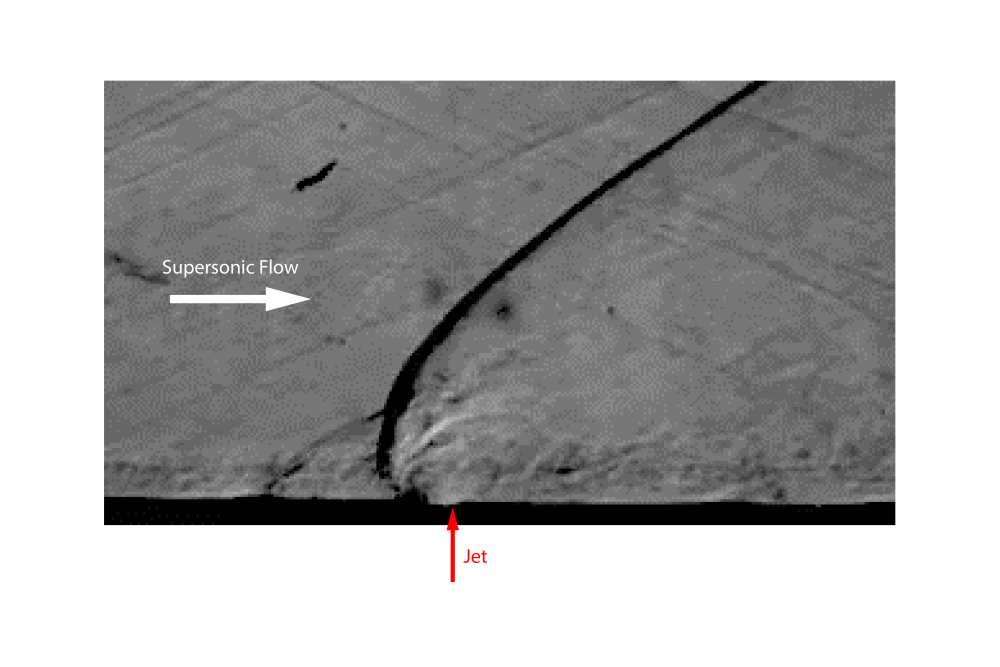
Supersonic air-breathing engines or scramjets are perhaps the most important technological hurdles towards the development of hypersonic transportation vehicles. In these engines, the air entering the combustor must remain supersonic, which significantly brings down the time available within the engine for fuel-air mixing and combustion. There are many possible strategies for fuel injection in such engines; the transverse jet injection into supersonic crossflow being one. We have experimentally studied the flowfield and mixing associated with such a sonic jet injection into a supersonic crossflow. In addition to detailed flowfield and mixing studies of the basic steady jet configuration, enhancement of mixing using a newly developed passively modulated (injection) jet has also been studied. In all cases, the flowfield has been investigated using Particle Image Velocimetry (PIV) to characterize the different flow features and the penetration of the jet into the crossflow, while mixing studies have also been carried out using acetone Planar Laser Induced Fluorescence (PLIF).